
REST vs GraphQL: Choosing the Right API Architecture
In the ever-evolving world of web development, choosing the right API architecture can make a significant difference in your application’s performance, flexibility, and overall user experience. Two prominent approaches that developers frequently debate are REST (Representational State Transfer) and GraphQL, each offering unique advantages and challenges.
Understanding REST API Architecture
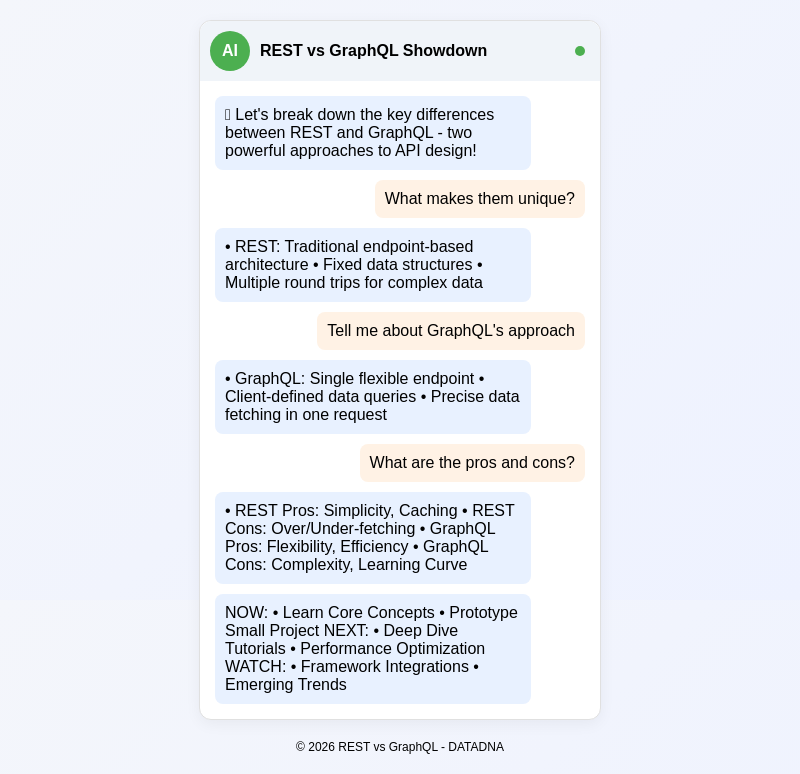
REST has been the standard API design approach for years, characterized by its stateless client-server communication model. In a REST architecture, resources are identified by unique URLs, and different HTTP methods like GET, POST, PUT, and DELETE are used to interact with these resources. This approach provides a clear, predictable structure for API interactions.
REST Advantages
REST APIs offer several benefits, including widespread adoption, simplicity, and excellent caching mechanisms. They work seamlessly with HTTP protocols and are easily understood by developers. Statelessness ensures that each request contains all necessary information, making scaling and load balancing more straightforward.
REST Limitations
However, REST has limitations. Multiple endpoints are often required to fetch related data, leading to over-fetching or under-fetching of information. This can result in unnecessary network requests and reduced performance, especially in complex applications with intricate data relationships.
Exploring GraphQL
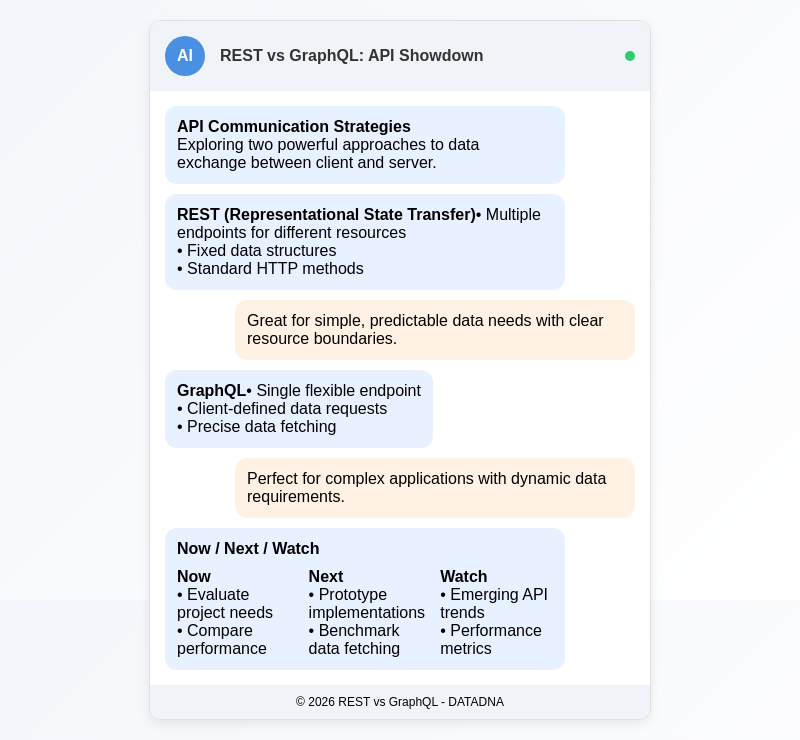
GraphQL, developed by Facebook, offers a more flexible approach to API design. It allows clients to request exactly the data they need, nothing more and nothing less. With GraphQL, you define a schema that describes your data’s structure and provide a single endpoint for all queries.
GraphQL Benefits
GraphQL’s primary strength lies in its ability to fetch multiple resources in a single request. Developers can precisely specify the data they need, reducing unnecessary data transfer and improving application performance. This approach provides more flexibility and efficiency compared to traditional REST architectures.
Choosing Between REST and GraphQL
The decision between REST and GraphQL depends on your project’s specific requirements. REST remains an excellent choice for simple, resource-driven applications with predictable data needs. GraphQL shines in complex, data-intensive applications requiring precise, efficient data fetching.
Consider factors like team expertise, application complexity, performance requirements, and long-term scalability when making your decision. Both architectures have their strengths, and the right choice will ultimately depend on your unique project context.
Leave a Reply